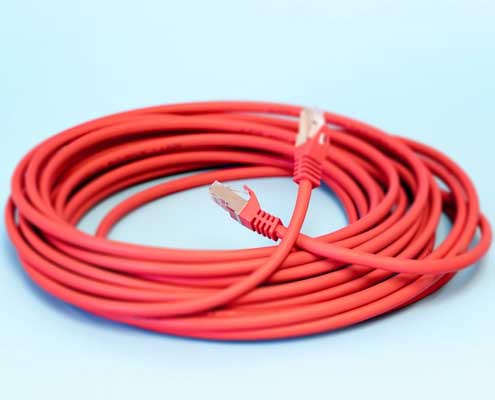


Cat5e vs CAT8 Cable: Understanding the Differences
5 Key Takeaways on Cat5e vs. Cat8 Ethernet Cables
- Speed & Bandwidth
Cat5e supports up to 1 Gbps over 100 meters.
Cat8 delivers up to 40 Gbps over 30 meters. - Use Cases
Cat5e is ideal for home and small office networks.
Cat8 is designed for high-speed, high-bandwidth applications like data centres. - Cost & Installation
Cat8 cables are typically 4–5 times more expensive than Cat5e or Cat6.
Cat8 requires more space for installation due to a larger bend radius. - Connector Compatibility
Cat5e uses standard RJ-45 connectors.
Cat8 uses GG45 or TERA connectors, which are not backward compatible with RJ-45. - Recommendation
Cat6a is usually the best choice for most home and office setups.
Cat8 is best reserved for short-distance, ultra-high-speed environments.
Can I use Cat 8 instead of Cat5e?
Cat5e and CAT8 cables can both be used for Ethernet networks, but they differ significantly in terms of performance and capabilities. In addition, Cat5e is commonly found in structured cabling installations. In contrast, Cat8 cabling is rarely seen and certainly not outside the data centre environment.
Cat5e (Category 5e) cable is an older standard that supports data transmission speeds of up to 1 Gigabit per second (1Gbps). This is based on a maximum distance of 100 meters. It is suitable for most home and small office network setups. This is because most networks run at a gigabit. However, the majority of modern switches, PCs, and Wireless Access points are starting to be based on 10-gigabit networks.
The main reason Cat5e cabling has been such a popular choice is Cat5e cables are relatively inexpensive and widely available.
On the other hand, Cat8 cabling (Category 8) cable is a newer and more advanced standard that offers significantly higher performance. It can support data transmission speeds of up to 40 Gigabits per second (40Gbps) over a distance of 30 meters. 24 meters of permanent link and 6 metres allowance of patch leads
Cat8 cables are designed for enterprise-grade networks and high-bandwidth applications. Examples would be Data centres and short link-to-link transmission.
Should I use Cat 8 at home?
Using CAT8 cable at home depends on your specific requirements and budget. Also the difficulties in installing need to be known
If you have a home network with devices that require high-speed and reliable connections you might consider a high-grade cable
Devices might include.
• gaming consoles
• streaming devices
• smart home systems
Cat8 ethernet cables can provide the necessary performance. However, Cat6a and Cat7 also provide 10 gigabit capabilities so maybe they are a better choice
It is important to note that Catt8 cables are generally more expensive than Cat5e or even Cat6 cables. As a general estimate 4-5 times the cost
If patch leads are only being used to link devices, the difference in cost will be minimal. However, installing cables around a house will make a big difference.
In addition, the cost will be larger but the installation requirements will also be massively different. Cat8 cables require a larger bending radius and thus more containment, more space, and deeper backboxes. In most cases, the back boxes will not fit in a standard plasterboard wall void.
In a home setting, we recommend neither Cat5e nor Cat8. Cat6a would be our choice for transmission performance, cost-effectiveness, and a cable that is suitable to install
Are Cat5e and Cat8 connectors the same?
Although both cables have 4 pairs, the connectors used for Cat5e and Cat8 cables are different.
Cat5e cables typically use RJ-45 connectors, which are the same connectors used for Cat6 and Cat6a cables. These connectors have eight pins and are widely compatible with various network devices.
In contrast, Cat8 cables require different connectors called GG45 or TERA connectors. These connectors have a different pin configuration and are specifically designed to support the higher data transmission speeds of Cat8 cables. The connectors have 4 additional connectors in the corners.
Cat5e cables can plug into Cat8 cables but the overall performance is then only that of a Cat5e link
Is it worth getting Cat 8 Ethernet cable?
The decision to invest in CAT8 Ethernet cable depends on your specific needs and network requirements. In addition, your budget and building suitability
If you have a network that demands high-speed and high-bandwidth connections, such as a large business network or a data centre, Cat8 can provide the necessary performance and future-proof your network. The link remember needs to be less than 24 meters to get the full benefit
However, for most home and small office networks, Cat5e or Cat6 cables are usually sufficient. However, Cat6a would be our recommendation.
Cat8 cables are more expensive and may require additional equipment. This needs to be taken into consideration. You will require compatible connectors and network switches to fully utilize the capabilities of Cat8 cabling.
Therefore, it's important to consider your network infrastructure, devices, and budget before deciding to upgrade to Cat8 network cabling
What is better, Cat 5e or Cat8?
In conclusion, Cat5e and CAT8 cables differ significantly in terms of performance and capabilities.
While Cat5e is suitable for most home and small office networks, Cat8 is designed for high-speed and high-bandwidth enterprise-grade networks.
The choice between the two depends on your specific requirements, budget, and the devices you use in your network. Our design team can help you choose the best installation.
Read more about Cat5e Cable FAQs – 19 Frequently Asked Questions
Also:
- Data Cabling Knowledge Centre
- What is the difference between Cat5 Cat6 Cat7 Cat8 Cabling?
- What is the difference between Cat6 and Cat6a
Claim Your Free Site Survey
Still not sure where to start? Let us help.
We offer a free, no-obligation site survey to assess your current setup and recommend the best data cabling or electrical solutions tailored to your business needs. Whether you’re planning a new installation or upgrading an existing system, our expert team will provide practical insights and clear advice - completely free of charge.
Simply fill in your details and one of our engineers will be in touch to arrange your on-site assessment.
Search the site
-
Data Cable Installation
-
NM Cabling Renews SafeContractor Accreditation 2026
-
Warehouse Wi‑Fi Solutions
-
Cat6e Cable
-
10 Questions to Ask Your Data Cabling Company
-
Wired or Wireless Security Cameras?
-
June 2025 Project Summary
-
Commonly Asked Questions About CCTV Systems in the UK
-
10 Common Data Cabling Problems and How to Solve Them
-
Cat 7 vs Cat 8 Cables