Cat 6e (Category 6 Enhanced)
Cat6e cable is a term that appears frequently when people are planning a network upgrade or a new installation. It is commonly assumed to be the next official step after Cat6, in the same way Cat5e replaced Cat5. In reality, Cat6e cable is not a recognised international cabling standard, but it has become a widely used term in the industry.
Most Cat6e cables are designed by manufacturers as an enhanced version of Cat6. They often offer improved shielding, better noise resistance, and higher performance than standard Cat6. However, because Cat6e is not governed by a formal standard, its specifications can vary significantly between manufacturers.
What Does the “E” in Cat6e Stand For?
The “e” in Cat6e simply stands for “enhanced”. Unlike Cat5e, which has a formal specification, Cat6e has no official specification. Each manufacturer decides which improvements are included, ranging from minor upgrades to performance levels approaching Cat6a.
This lack of standardisation is why Cat6e should be viewed as a descriptive term rather than a guaranteed performance category. It can be useful as a concept, but it should not be relied upon for critical or long-term network planning.
Cat5 vs Cat6e
Cat5 cabling is now considered obsolete and unsuitable for modern network requirements. It lacks the bandwidth, noise resistance, and power handling needed for today’s applications.
Cat6e offers a significant improvement and supports higher speeds, modern PoE devices, and denser networks. For any new installation, Cat5 should be avoided entirely, with Cat6e or higher being the minimum expectation.
Cat6 vs Cat6e
Cat6 supports 10Gbps speeds but only over limited distances. In real-world installations, performance can drop when cables are bundled together or installed near sources of electrical interference.
Cat6e is typically designed to improve on these limitations by offering better crosstalk performance and improved shielding. While this can make Cat6e more reliable than Cat6 in some environments, the lack of a recognised standard means results are not always consistent.
Cat6e vs Cat6a Cable
This is where the most important distinction lies. Cat6a is a fully recognised international standard and provides guaranteed performance. It supports 10 Gbps at distances of up to 100 metres, operates at a 500 MHz bandwidth, and offers superior protection against interference and crosstalk.
Cat6e, by comparison, may support similar speeds but usually only over shorter distances, typically up to 55 metres. Because performance is not guaranteed, Cat6e cannot offer the same level of certainty as certified Cat6a.
For this reason, NM Cabling installs Cat6a as standard on the vast majority of projects. It provides a future-proof solution that meets current standards and avoids performance compromises.
https://www.nmcabling.co.uk/cat6a-installation/
Is Cat6e Better Than Cat6?
In most situations, Cat6e does perform better than Cat6. It generally offers improved noise resistance and is better suited to modern PoE-powered devices and high-density installations.
While Cat6e may be an improvement, Cat6a remains the superior choice. Where long-term reliability and scalability are required, Cat6a remains the recommended option.
What Is Cat6e Cable Used For?
Cat6e is commonly considered for office refurbishments, Wi-Fi upgrades, VoIP systems, CCTV, and education environments. Many organisations are upgrading their infrastructure to support higher data speeds and increased power demands.
In schools and colleges, the Department for Education specifies that new cabling should meet Cat6e or Cat6a performance requirements. In practice, Cat6a is the most reliable way to meet these guidelines and ensure compliance.
Cat6e and Cat6a are often installed as part of a wider structured cabling system, supporting switches, Wi-Fi access points, and future network expansion.
https://www.nmcabling.co.uk/structured-cabling/
Cat6e Outdoor Cable
External Cat6e or Cat6a cable is sometimes used to connect small buildings or remote network points. Typical examples include gatehouses, security huts, and home garden offices that require a dedicated network connection.
A common misunderstanding is that an external-grade cable is immune to damage. In reality, anything installed outdoors is exposed to risks such as vehicle movement, groundworks, and animal damage. Even an armoured cable can be damaged if it is not properly protected.
Where buildings need to be permanently linked, fibre optic cabling is usually the best long-term solution. Copper should only be used where distances are short and risks are low.
Cat6e Shielded Cable
Most Cat6e and Cat6a installations use some form of shielding, such as foil-shielded designs. Shielding is particularly important in environments with high levels of electrical interference, including warehouses, manufacturing facilities, and areas with heavy machinery.
NM Cabling regularly installs shielded cabling systems in these environments, as well as for European IT companies, where shielding is often mandatory. Correct earthing and bonding are essential, as poor installation can reduce performance rather than improve it.
Cat6e Colour Code
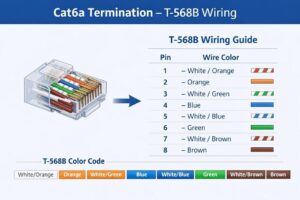
Cat6e cabling follows standard Ethernet wiring conventions, using either the T568A or T568B wiring scheme. The key requirement is consistency, as both ends of the cable must be terminated to the same standard.
Incorrect colour coding or poor termination is one of the most common causes of network faults and performance issues.
Cat6e Patch Cable
Cat6e patch cables are used to connect devices to wall outlets and to link patch panels to network switches. These short connections are often overlooked, but they play an important role in overall network performance.
Using patch leads that do not match the standard of the permanent cabling can introduce bottlenecks. Even in Cat6a installations, poor-quality patch leads can reduce achievable speeds.
Correct termination is critical to the performance of any network cable. Maintaining cable twist as close as possible to the termination point helps preserve signal integrity and reduce interference.
At NM Cabling, all cabling is installed using manufacturer-approved components and fully tested to ensure it meets the required performance standards before handover.
Free Cat6e Cabling Site Survey
Not sure where to start? Let us help.
We offer a free, no-obligation site survey to assess your current setup and recommend the best data cabling or electrical solutions tailored to your business needs. Whether you’re planning a new installation or upgrading an existing system, our expert team will provide practical insights and clear advice—completely free of charge.
Simply fill in your details, and one of our teamwill be in touch to arrange your on-site assessment.