

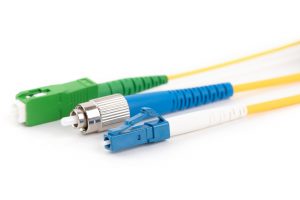
What is Passive Optical Network?
Passive Optical Network (PON) is a type of fibre-optic access network. A PON reduces the amount of cabling and equipment required compared to an active optical network, where each user has a separate connection to the network hub. Generally, a PON configuration contains an optical line terminal (OLT) at the service provider's central office and a number of optical network units (ONUs) or optical network terminals (ONTs) near end users.
How does it work?
PON uses an optical splitter to allow multiple subscribers to share a single fibre connection to the service provider's network. Furthermore, the splitter is a passive device that does not require any power.
The OLT contains a laser that sends an optical signal down the fibre to the splitter. As a result, the splitter then separates the signal into multiple signals, each of which is sent to a different ONU or ONT.
The ONU or ONT converts the optical signal back into an electrical signal that can be used by the customer's equipment.
Advantages
PON offers a number of advantages over other access technologies, such as, twisted pair or coaxial cable:
- PON is more scalable. It is easier to add new subscribers to a PON system than other types of network.
- The passive components in a PON system do not require power, which means that there are fewer potential points of failure.
- Cost-effective - the use of optical splitters means that a PON system can serve many subscribers with a single fibre connection. As a result, this reduces the amount of cabling and equipment required compared to other types of network.
Disadvantages
PON has a number of disadvantages compared to other access technologies:
- PON is more vulnerable to environmental factors. For example, components can be damaged by water, humidity, or temperature extremes.
- The OLT and ONU/ONT equipment required for a PON system is more expensive than the equipment required for other types of network.
- Longer installation times - Passive optical components must be carefully installed and aligned, which can take longer than other types of network.
What is Ethernet Passive Optical Network?
Ethernet Passive Optical Network (EPON) is a type of Passive Optical Network (PON) that uses Ethernet as the transport protocol. EPON is standardized by the IEEE 802.3ah committee.
EPON offers a number of advantages over other PON technologies:
- Uses a standard Ethernet interface, which simplifies equipment compatibility and reduces costs.
- Supports a wide range of data rates, from 10Mbps to 1Gbps.
- Can be easily upgraded to support higher data rates by simply changing the optical transceivers.
What is Gigabit Passive Optical Network?
Gigabit Passive Optical Network (GPON) is a type of PON that supports data rates up to 2.5Gbps downstream and 1.25Gbps upstream. GPON is standardized by the ITU-T G.984 series of recommendations.
What is Next Generation Passive Optical Network?
Next Generation Passive Optical Network (NG-PON) is a type of PON that supports data rates up to 40Gbps downstream and 10Gbps upstream. NG-PON is standardized by the ITU-T G.989 series of recommendations.
Advantages of GPON & NG-PON over other PON technologies:
- Supports very high data rates, making it ideal for applications such as HDTV and video-on-demand.
- GPON & NG-PON are scalable - it is easy to add new subscribers or upgrade existing subscribers to higher data rates.
- Cost-effective: the use of optical splitters means that an NG-PON system can serve many subscribers with a single fibre connection. As a result, this reduces the amount of cabling and equipment required compared to other types of network.

-
Data Cable Installation
-
NM Cabling Renews SafeContractor Accreditation 2026
-
Warehouse Wi‑Fi Solutions
-
Cat6e Cable
-
10 Questions to Ask Your Data Cabling Company
-
Wired or Wireless Security Cameras?
-
June 2025 Project Summary
-
Commonly Asked Questions About CCTV Systems in the UK
-
10 Common Data Cabling Problems and How to Solve Them
-
Cat 7 vs Cat 8 Cables