
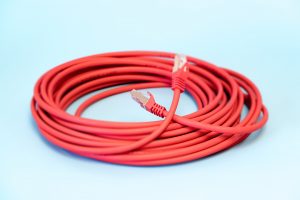

What does the term "data cable" mean?
A data cable is a cable that connects two devices to transfer data. Data cables can be broken down into three main types.
- Twisted pair cabling.
- Coaxial cabling.
- Fibre optic cabling.
We discuss what each type of data cable is and where they are used most often by breaking them down into these categories.
Data Cables - How to Choose the Category
There are a few things you should keep in mind when choosing the right category of data cable:
- The type and quality of cabling is determined by its performance characteristics, such as speed or power.
- Data cables must be selected based on their intended use. For example, network cables can vary depending on how many applications will run over them simultaneously. You may also need to consider distance limitations.
- The most common choice is Copper Category Cables, which are twisted-pair wires covered by an outer sheath (shield). Twisted pair wire conductors consist of two uninsulated copper wires wrapped around each other to minimise interference. In addition, 4 pairs are contained in a single cable.
- The higher the category number (CAT), the better the cable's speed and distance performance. For instance, a Cat 7 cable is faster and can support longer distances than a Cat 6 cable.
Twisted Pair Data Cabling
Twisted-pair cabling is the most common type of data cable, consisting of two insulated copper wires twisted together. This type of cabling is used in a variety of applications such as home networks, office networks and even audio/video applications. The most common type of twisted-pair cabling is Cat cable.
- Cat5e Cabling.
- Cat6 Cabling.
- Cat6a Cabling.
- Cat7 Cabling.
- Cat8 Cabling.
Cat-cable, or Category cable, is the most commonly used and versatile type of copper cabling and has been proven extremely reliable. This category was first introduced as Cat5 in 1995 by the Electronic Industries Alliance (EIA). The standard for Cat cables is regularly updated, but their name always remains consistent. The category is usually determined by the performance the cable is capable of over a set distance of 90 metres for a permanent link.
Shielded Twisted Pair Cables
Twisted pair cables are also available with special shielding, which can help minimise interference from other devices such as microwaves and cell phones. These types of shielded cable are referred to as STP (shielded twisted pair) category cables.
Shielded data cables are typically used in situations where the cabling needs additional protection against EMI (Electromagnetic Interference) and RFI (Radio Frequency Interference).
This type of cabling is often used in industrial or medical settings where there is a greater risk of noise and interference. Shielded cables have a metal foil or braid shield around the conductors to help reduce unwanted signals.
Coaxial Cabling
Coaxial cabling consists of a single copper wire that surrounds an insulated copper wire. This type of data cable is mainly used in video applications such as CCTV, security systems, and satellite TV installations. Coaxial cabling has a higher bandwidth than twisted-pair cabling.
Coaxial cabling is a type of data cable that uses an inner conductor surrounded by an insulating layer, then a braided shield, and finally an outer sheath. This type of cabling is used in home cable services and business networks.
Categories for coax cables are divided into two:
- - Foam Polyethene Insulation (Foamed PE).
- - High-Density Polyethene Insulation (HDPE).
Uses for Coaxial cabling include:
Data Centres, telephone and cable TV systems, and large-scale mobile phone booster installations.
Fibre Optic Cabling
Data cables can also be made of fibre-optic cabling. This type of data cable has a glass or plastic core with an insulating layer, surrounded by ultraviolet light-transmitting fibres that are protected by protective materials.
Optical fibre cables work largely the same way that normal twisted pair cables do, except for one key difference. Instead of sending electrical signals down the wire, they send light pulses through an optical glass tube, otherwise known as an optical core. These signals can travel tens of thousands of kilometres.
The main advantage of fibre-optic cables over copper cables is higher bandwidth, which allows large amounts of data to be transferred at high speeds without the need for repeaters. This is because they have multi-gigabit capacities. These signals degrade less over long distances. There are fewer distance limitations with fibre-optic cables than with copper data cables.
Common uses of data cables
Now that we have discussed the types of data cables, let's look at where they are most commonly used.
Twisted pair cabling is by far the most popular type of data cable. It can be found in a variety of applications, including home and office networks, commercial wireless systems, and audio/video applications. Coaxial cabling is mainly used for video applications. It can be found in products such as televisions and video players. Fibre optic cabling is the most advanced type of data cable. It is often used in high-speed applications such as networking, telecommunications, and data centres.
Is Ethernet and a data cable the same?
No. Ethernet and Data cabling are not the same thing, although they are closely related in function.
Ethernet was developed as a method for connecting different types of devices on a network, such as computers, printers, and routers. However, data cables were designed to connect these various Ethernet devices together. This is achieved by sending electrical signals down the wire at high speeds, allowing it to send information quickly between them (e.g., 1000 Mbps).
Data Cables Summary
When selecting category cabling, it is important to know which type will work best for your needs. If you have any questions or need help choosing the right type of data cable, please don't hesitate to give us a call.
Hopefully, this blog post has given you a better understanding of what a data cable is and the different types that are available. Stay tuned for our next post, which will discuss data cables and associated services in more detail.
