What is the difference between Cat5 and Cat6?
Cat5, now commonly known as Cat5e and Cat6, are in many ways very similar. Furthermore, their transmission in some cases is also quite similar. However, there are a few ways in which Cat6 excels Cat5e in performance. The difference between Cat5 and Cat6 includes:
- They are constructed slightly differently
- Cat6 cabling has a higher bandwidth capability
- Cat6 data cabling is capable of 10 gigabit Ethernet speeds at short distances
- There is a difference in material costs
Cat5 and Cat5e Cabling
When comparing Cat5 and Cat6 cabling, what we are really comparing is Cat5e and Cat6. In short, Cat5e replaced Cat5 as the standard in 2001. Furthermore, Cat5e could transmit 1 Gigabit Ethernet, which was previously unattainable with the previous standard.
Generally, Cat5 cabling is still the default term when discussing the installation of large amounts of data cabling. However, it is sometimes used when actually Cat5e, Cat6, Cat6a or beyond is actually required. Therefore, when we compare modern Cat5 and Cat6, we are comparing them to their enhanced versions.
Construction of the data cable
To the naked eye, both types of data cable look very similar, if not identical. However their are differences in overall size and the reasons for the size increase
- The overall diameter of a Cat6 data cable is around 10% larger. Although this isn’t much for a single cable, if hundreds of cables are involved, it makes a big difference. Subsequently, a larger containment size is required. Furthermore, tray work and conduits may need to be increased
- The individual cores in a Cat6 cable are more tightly twisted. The cores are twisted to reduce mutual interference. Therefore, by a tighter twist, the chances of a similar signal clashing along the cable are minimised
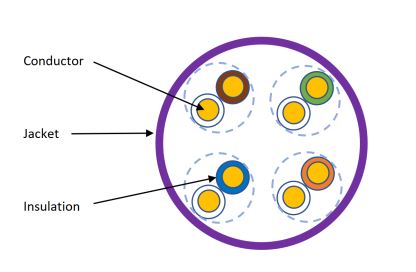
- The Cat6 cable has a central plastic separator. In both cables, the cores are twisted into 4 pairs (8 cores overall). In addition, the Cat6 cable’s central separator splits the 4 pairs into separate sections. The diagrams below illustrate this:
 |
 |
Difference between Cat5 and Cat6 Bandwidth Capability
Bandwidth is the range of frequencies available for transmitting data along a data cable. Therefore, more data information can be carried over a larger bandwidth. Furthermore, it is the amount of data that can be transferred at one time
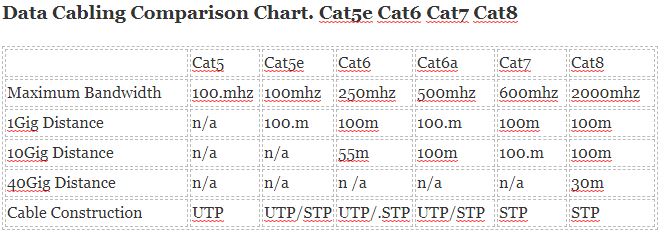
In short, Cat6 cable has more than twice the bandwidth capability of Cat5e cable. Indeed,d the comparison is 250Mhz against 100Mhz
Gigabit and 10 Gigabit Ethernet
A large portion of technology will be built based on the transmission capabilities of its hardware. For example, a PC may have a 1 Gigabit or 10 Gigabit Ethernet card built in. Furthermore, a data switch in the comms cabinet will be rated similarly.
This is one way Cat5e and Cat6 differ in their capabilities. However, they only differ in their capabilities and not in the ratified data cabling standards
All Copper data cabling is ratified on its performance over a 90m permanent link. For this reason, over 90m, Cat5e and Cat6 cables can only transmit 1 Gigabit Ethernet. However, Cat6 cable can transmit 10 Gigabit Ethernet up to 55 metres. However, when designing a structured cabling installation, if 10 Gig is required, then the overall cabling design should allow for Cat6a as a minimum. For this purpose, it is the minimum standard for a 10Gig install
The chart below shows the different Data Cabling standards and their capabilities as an example
Difference between Cat5 and Cat6 Material Costs
When comparing the overall installation costs of the two categories, the main difference is in the materials. For the most part, the installation time of both cables is the same. Therefore, the difference is in the materials.
The structured cabling system components for any link are
- The cable itself
- Patch Panel
- Data Module
- Patch Leads
Each of these components costs more in Cat6 cabling. However, the larger the installation, the less the overall percentage increase in cost will be. In summary, Cat6 cabling will be approximately 15% more when compared with Cat5e cabling
In addition, due to Cat6’s larger size, in some cases, larger containment will be required. Generally, on a new installation, this will not make much difference as different containment can be chosen. However, if containment is in place but not suitable, a swap-out cost may be incurred.
For similar articles regarding the difference between Cat5 and Cat6, please visit our Knowledge Center HERE

For a Free Quotation, please email [email protected] or call 01923 888588