Fibre Optic or Copper Data Cabling – Which Should You Choose ?
Fibre Optic v Copper Data Cabling.
Structured cabling offers a whole system of cables along with connectors and related hardware. This is applicable both for voice and data cabling. Furthermore it is applicable for enterprise data network as well as office fit out cabling. Your preference for IT cabling installations can directly affect the productivity of your IT arrangements. Furthermore the trouble-free and fast transfer of data across the network. In addition the power consumption, and the overall impact on the environment. Usually, enterprise IT networks consider copper data cabling. Usually from the Cat 5e,Cat 6 and Cat6a specifications for data cabling. In certain cases its important to consider the merits of fibre optic v Copper cabling in your applications
Copper Cabling
Copper cabling is suitable for short-range connections of up to 100 metres and is typically used to support standard desktop and office applications. However, as data throughput, transmission speeds, and bandwidth requirements continue to increase, more advanced cabling solutions are needed.
Modern commercial and telecommunications environments now demand cabling capable of supporting speeds of up to 10 Gb/s. For example, Audio-Visual (AV) systems are increasingly being integrated with IT networks using Internet Protocol (IP). Advancements in IT cabling technology have led to the wider adoption of 10 Gigabit Ethernet cabling, enabling data transfer speeds of up to 10 Gb/s over Ethernet networks.
In addition to that, the length of cable and higher speed of data transfer needed for the most advanced business system led to introduction of Electro-Magnetic Interference (EMI), even in 10gig Cabling. The installation of 10G cabling is comparatively complicated and demand for high skills and expertise.
Types of Copper Cabling
- Coaxial
- Cat5e
- Cat6
- Cat6a
- Cat7
- Cat7a
- Cat8

Fibre Optic Cabling
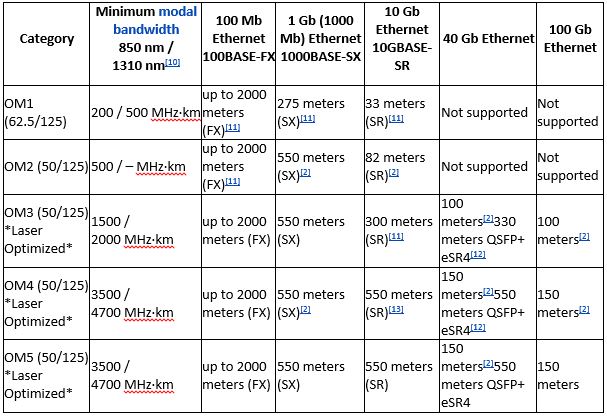
Fibre optic cabling contains very thin fibres of plastic or glass, which are called optical fibres. Every strand is capable of carrying approximately 25,000 calls. Thus, an office fit out cabling based on fibre optics has the capacity to field up millions of calls. The network bandwidth and speed of data transmission is also substantially higher through fibre optic cabling as compared to copper cabling. A broadband based on optical fibre can normally provide the speed which is five to ten times faster as compared to traditional DSL broadband.
Fibre optic cabling also consumes less space, is less heavy, and has a higher density, and fibre splicing allows it to be laid in much longer runs. Expert organisations are preferring fibre optic cabling for increasing number of process and data-intensive applications. This includes Unified Communications (UC), and access to cloud-based and cloud hosted services.
Types of Fibre Optic Cabling
- Singlemode – OS1
- Singlemode – OS2
- OM1 – Multimode
- OM2 – Multimode
- OM3 – Multimode
- OM4 – Multimode
- OM5 – Multimode
About NM Cabling Solutions – Structured Cabling Specialist
NM Cabling is a technology and computer cabling integrator working throughout the United Kingdom.
We have created a comprehensive Knowledge Centre for our industry which can be viewed at https://www.nmcabling.co.uk/knowledge-centre/
Claim Your Free Site Survey
Not sure where to start? Let us help.
We offer a free, no-obligation site survey to assess your current setup and recommend the best data cabling or electrical solutions tailored to your business needs. Whether you’re planning a new installation or upgrading an existing system, our expert team will provide practical insights and clear advice – completely free of charge.
Simply fill in your details and one of our engineers will be in touch to arrange your on-site assessment.