6 Major Factors Affecting Fibre Optic Performance
Fibre-optic cable has an amazing bandwidth. However, it is often restricted by the hardware either side of the cable rather than the bandwidth of the cable itself. Furthermore, performance can be affected by the installation of the Fibre Optic Cabling. The FIA provides standards and quality guidance and can be found HERE. Here are some of the key factors affecting the performance of fibre optic London installations.
What is Fibre Optic Cabling?
Fibre optic cabling is a type of high-speed data transmission medium that uses light to carry information over long distances. Unlike traditional copper cables, fibre optics transmit data as pulses of light, which allows for faster speeds, higher bandwidth, and minimal signal loss. Fibre optic networks are widely used in telecommunications, internet infrastructure, and modern data centres because they provide reliable, efficient, and scalable connectivity for both commercial and residential applications.
What is Fibre Optic Cable Made Of?
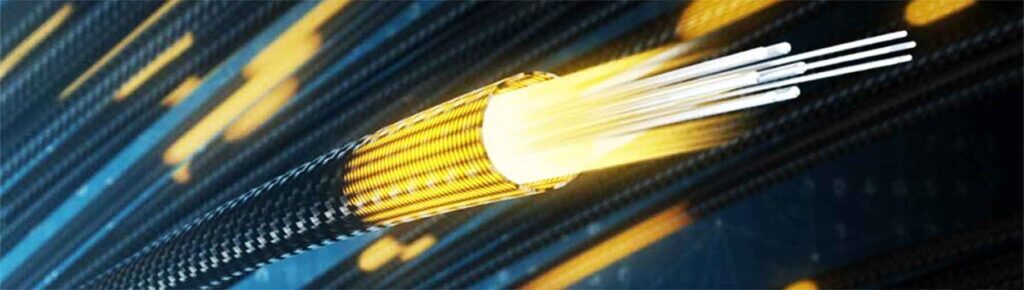
A fibre optic cable consists of very thin strands of glass or sometimes plastic, each no thicker than a human hair. These strands, called cores, carry light signals that transmit information at incredibly fast speeds. Each core is coated with a protective layer of glass or plastic to maintain signal quality and prevent damage. The cores are then bundled together and enclosed within a durable outer sheath, usually made of plastic, which protects the delicate fibres from physical stress, moisture, and environmental hazards.
What is Fibre Optic cable used for?
Fibre optic cabling is primarily used in a fibre optic installation as a backbone link between buildings, cabinets and locations. These locations thus serve localised network data cabling via copper structured cabling
Copper data cable has a maximum distance of 100m. Therefore, when distance and bandwidth are an issue, fibre optic cabling is installed.
Fibre Optic cable installations are also increasingly being used for short distance high speed and high bandwidth link and communications. These can be within a data centre between cabinets or fibre to the desk for high speed computer links
What Impacts the Performance of Fibre Optic Cables
When it comes to fibre optic installations in London, several factors can significantly impact performance. These key elements must be considered to ensure optimal functioning:
- Incorrect Specification of Fibre Optic Cabling
- Using the wrong type of fibre optic cable for the application can lead to signal loss, reduced speed, and poor overall performance. It’s important to match the cable type with the specific needs of the network.
- Poor Fibre Optic Cabling Connector Terminations
- Improper termination of fibre optic connectors can cause signal degradation and connection issues. Ensuring connectors are terminated correctly is essential for maintaining high-quality performance.
- Dirty Fibre Optic Cabling Connector Ends
- Contaminants such as dust, oil, or dirt on the connector ends can severely impair the performance of fibre optic cables. Regular cleaning of connectors is essential to avoid signal loss or disconnections.
- Poor Installation of Fibre Cabling
- Improper installation techniques, such as bending cables too sharply or failing to secure them properly, can lead to physical damage to the fibres, reducing their effectiveness and lifespan.
- Incorrect Fibre Optic Patch Leads
- Using the wrong patch leads (e.g., mismatched fibre types or incorrect lengths) can result in poor signal transmission, potentially disrupting network performance.
- Crossed-over Fibre Optic Patch Lead
- Incorrectly connected patch leads, such as fibre cables being “crossed over,” can cause improper routing of signals, leading to network issues and reduced speeds.
Attention to these factors is critical to ensure fibre optic systems function at their best, providing reliable and high-speed network connectivity.

Incorrect specification of fibre optic cabling
If the speed you wish your network to run on doesn’t have the correct fibre optic cabling installed, it will never run at the desired speed. For example, for 10Gig speeds and links the maximum cable length varies. For example, the fibre optic cable ranges from OM1 (33metres), OM2 (82metres), OM3 (300metres) to OM4 (400metres). Exceed this distance or pick the wrong fibre optic cable and your network will not perform at the desired speed and standard
Likewise, there is a consideration between singlemode and multimode fibre optic. Singlemode fibre cable is a single core of fibre cable. Conversely, a multimode fibre cable is made up of multiple glass modes along the cable. Likewise, singlemode light transmission is via a laser rather than a light source. Therefore, although the speeds and distances achievable are greater the overall cost of the link and hardware are greater.
For example a lack of investment in the correct fibre optic links and hardware could have a limiting effect on your connection speeds and bandwidth
Poor connector terminations
The connector starts with firstly making the correct choice of fibre optic connector. Each fibre optic connector chosen must match the existing patch panel connectors as the different types are not interchangeable and don’t fit into one another
The ST fibre connector was the connector of choice for some time but has been surpassed by the SC and LC connectors with the LC now the connector of choice for its performance and low density patching characteristics
Additionally, if the fibre optic cabling connector ends are poorly terminated or the ends bent too sharply then the light passing through will either be limited or at too low a range for the transmission to be connected. Light could still be shining through a fibre optic cabling links but not have enough transmission quality to create the data link.
With fusion splicing and correct terminations, standard optical fibre cabling speeds can be guaranteed.
Dirty connector ends
If the fibre optic cabling connector ends become dirty then the transmission can be intermittent or not work at all. Keeping the unused optical fibre cabling connectors covered when not in use goes a long way to alleviating this problem
Dirty connector ends can be caused during the termination process. However they are more commonly caused during un-patching and re-patching of fibre optic patch leads and links. Care should be taken to clean the fibre optic ends each time patching is undertaken
Poor installation
Fibre optic cabling has a specific bend radius and pulling tension guidelines. These are to be followed when installing the main cabling runs. If the cable becomes stretched or bent too tightly then the quality of light down the cable is compromised. Therefore, resulting in a poor or non-existent performance.
The cable construction has strands of Kevlar surrounding the inner fibre optic cores which helps protect the cable from damaged. However, the fibre optic cable is at its weakest at the termination ends where the glass cores are exposed for termination.
Care should be taken at the termination ends to avoid excessively bending or crimping the cable into place for termination as this causes breaks in the cable cores. The correct termination box or panel should be selected to help alleviate this problem
Patch Leads
With regular patching and un-patching the patch leads can become scratched or dirty. The weakest part of the link creates the overall quality of the link as a whole, which means a poor patch lead can create a poor link overall. Fibre optic patch leads should be cleaned each time they are re-patched
There are also several different categories of fibre optic cabling with different performance, core size and suitability. Installing a lower category of patch lead to a higher level cable will reduce the performance of the over link
A single mode patch lead is 9microns in diameter compared to 50 microns in a Om2-Om5 cable. Installing the incorrect patch lead in this case reduces light transmission area at the termination by 80% in both transmitting and receiving
Crossed patch leads
More of a cause of no performance than poor performance the biggest reason a fibre optic link doesn’t work after installation is the patch leads are not patched for the correct fibre optic cabling link.
In a standard fibre optic link core 1 on the transmitting end will send to core 2 on the receiving end and vice versa.
However, some installations will directly match and connect the cores in order transmitting from position one and receiving on position one. In this scenario crossover patch leads are used to create the transmit and return loop
If the installation type and patch leads are not in unison then the transmitting hardware will send to the opposite transmission side and the link will not work.
The first place to check when a link doesn’t work is by swapping around the patch lead cores at one end of the link and re-testing the link.
for more fibre optic articles please visit the knowledge centre
NM cabling are leading Fibre Optic installers in London.
Claim Your Free Site Survey
Get a Free Fibre Optic Survey – Plan Your Installation with Confidence
Simply fill in your details and one of our engineers will be in touch to arrange your on-site assessment.